Marist 100 is a plan developed at an exciting time in the College’s history. We approach our centennial in 2029 from a position of incredible strength, reflecting upon and celebrating Marist’s remarkable growth and development over its first 100 years; reaffirming our commitment to the ongoing relevance and distinctiveness of our mission, values, and model of higher education; and thinking boldly about the years that lie ahead.Our Strategic Plan will help make a Marist education accessible to a broader range of talented students and will help us carry out our ambitious vision of improving the world through education.Read More
Marist’s School of Management welcomes Dr. Will Lamb as dean.
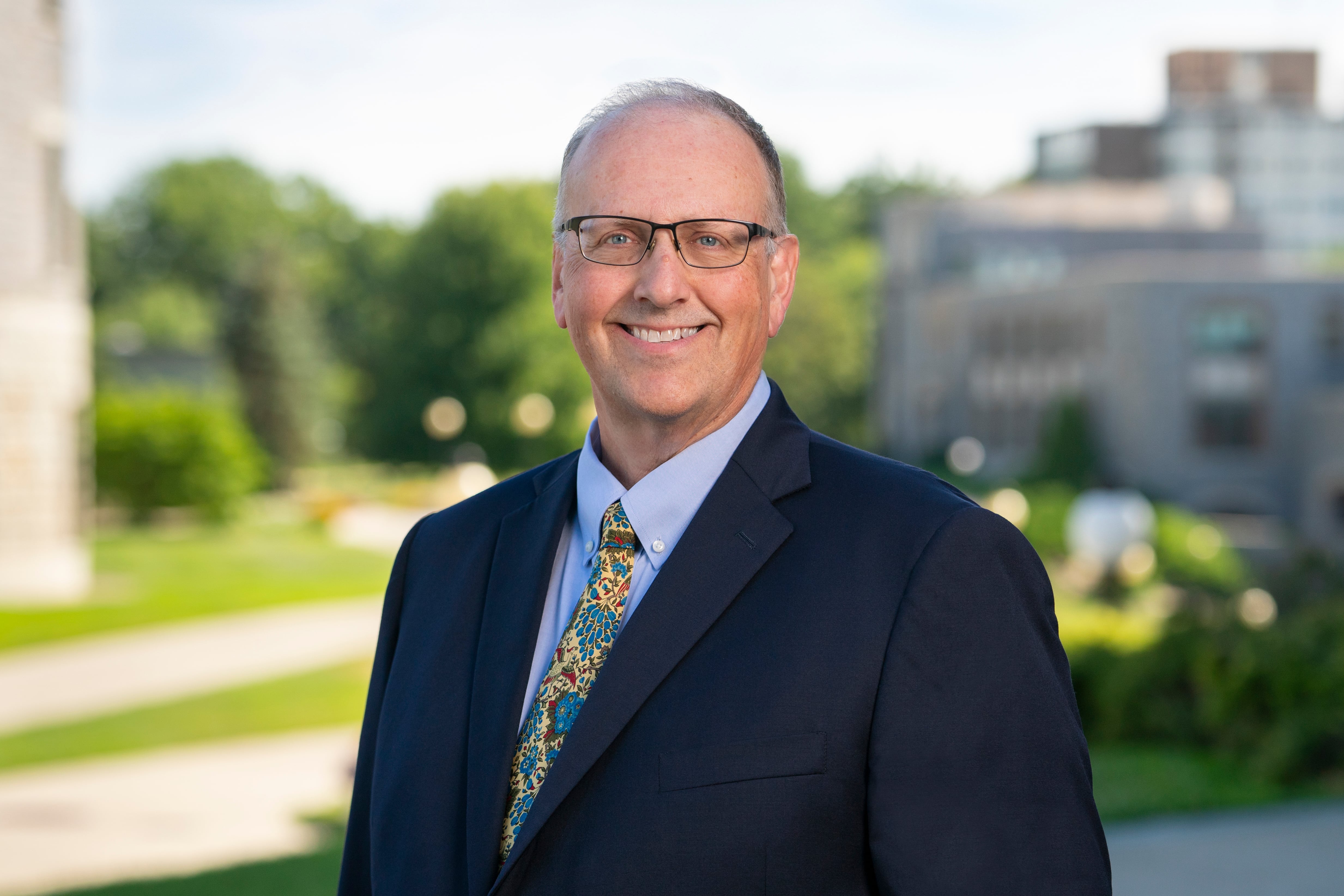
Following a national search, Marist College appointed Dr. Will Lamb as dean of the School of Management. Lamb brings a wide variety of experience to Marist, most recently serving as dean of graduate and adult learner recruitment at EAB Global, where he helped colleges and universities improve the strength of their academic programs and grow their enrollments. He previously served as dean of the LaPenta School of Business at Iona College, the Murata Dean of the F.W. Olin Graduate School of Business at Babson College, and associate dean for graduate programs at Ohio University.
“Dr. Lamb comes to Marist and to the School of Management at an exciting and pivotal time,” said Dr. Kevin Weinman, Marist president. “With growing undergraduate enrollment in the school, several renowned graduate programs, and a transformational renovation and expansion of the home of School of Management, the Dyson Center, now underway, the School is poised for an incredible future. I was immensely impressed with Will’s vision, strategic thinking, and excellence as an operational leader, and I have great confidence that Will can take the School to new heights.”
“My experience at EAB has provided a unique opportunity to learn about the market for higher education, and to work with people at nearly every type of school and in all regions of the country,” said Lamb. “This position at Marist College offers an opportunity to work in a student-centered, liberal arts environment at a moment in the College’s development that presents significant opportunities for the School’s future growth and direction.”
Lamb has extensive experience working as both faculty and dean at several institutions with highly regarded business schools. During his leadership of Iona’s LaPenta School of Business, he oversaw the faculty’s revision of the business curriculum and made significant enhancements to the MBA, MS in public accounting, and MS in finance programs. He also oversaw the development of Iona’s online MBA program.
At Babson, he was responsible for the oversight and administration of the College’s four MBA programs, MS in accounting, and MS in management—programs that served more than 1,000 graduate students annually. While there, he led the development of two new programs: the MS in finance and the MS in business analytics.
While at Ohio, Lamb moved through the ranks from assistant professor to director of the MBA program, chair of management systems, and associate dean for graduate programs. Prior to Ohio University, he served as assistant professor of management at Millsaps College in Jackson, MS.
“The School of Management at Marist is renowned for its graduate and undergraduate programs,” said Lamb. “With this tremendous foundation already in place and the coming expansion and transformation of the Dyson Center, our students will have world-class resources at their fingertips to grow and succeed in their future endeavors.”
He has a PhD from Virginia Tech and a BA and an MEd from the University of Virginia.
Marist is grateful to alumni, parents, and friends for their support and dedication
The following generous contributions honor our donors’ commitment to education and ensure they are forever associated with the College’s mission and success.
SUPPORT FOR SCHOLARSHIPS
Scholarships are essential in higher education, providing critical financial support and recognizing academic achievement, leadership, and community involvement.
Trustee Dirk McMahon ’82 and his wife Wendy have made an additional generous gift in support of the Dirk and Wendy McMahon Endowed Scholarship for incoming freshmen majoring
in business administration at Marist College with demonstrated financial need and strong
leadership potential.
A generous gift from Bayly Ledes and the Ledes Foundation recently established the John G. Ledes Endowed Scholarship. This new scholarship recognizes the extraordinary legacy of John G. Ledes in the beauty publishing and fragrance industries. It will be awarded to a rising junior with financial need and a demonstrated interest in the beauty industry, including publishing, design, marketing, merchandising, or fragrances.
Maureen Sorbo Logan ’78 and Mark Logan have made an additional gift to the Mark and Maureen (Sorbo ’78) Logan Scholarship, which supports Mid-Hudson Valley students with significant financial need majoring in STEM, accounting, or finance. This scholarship is awarded to students
of high character with leadership potential and proven academic ability, with preference given to graduates of Poughkeepsie High School and other Dutchess County high schools.
NAMING COMMITMENTS
Marist College has recently received several generous pledge commitments supporting key areas of the institution, highlighting the importance and impact of naming commitments on campus development and growth.
Dyson Center Renovation and Expansion
Set to open this summer, the renovated and expanded Dyson Center has attracted significant support. Members of the Class of 1968 have made a generous pledge to name the Social and Behavioral Sciences Dean Suite in honor of their 55th reunion. Additionally, Pike Construction’s pledge to name the Rooftop Terrace will enhance the new space, while a gift from the Edward Taylor Coombs Foundation to name a classroom will directly impact students and faculty.
Track and Turf Field Support
The Track and Field fundraising effort began with a $1 million lead commitment from Marist Trustee Tim Tenney, established as a dollar-for-dollar matching challenge to catalyze momentum and encourage further donations. To date, the College has received $421,483 in additional gifts and pledges from 267 donors, including generous pledges from Trustee C. James Taylor, Jay Doyle ’75 to name the Record Board, and Jamie McGurk ’97 to name the Plaza in the enhanced athletic space.
“Naming commitments are vital gifts to Marist because they provide essential financial support for the institution’s growth and development while also creating lasting legacies that inspire future generations,” said Vice President for Advancement Chris DelGiorno ’88.
To explore the wide range of naming opportunities at the College, please contact Chris at chris.delgiorno@marist.edu.
Generosity and community have always been at the heart of Marist’s identity. This legacy, which has endured for nearly a century, has recently gained extraordinary momentum as alumni, parents, faculty, staff, students, and friends of the College have stepped forward with unprecedented enthusiasm to provide philanthropic support for various elements of Marist’s mission and vision.
Marist is at an inflection point in its evolution, with philanthropy acting as a powerful accelerator.
Although Marist is a relatively young institution – with more than 60% of its 51,000 alumni having graduated in the last 25 years – the collective force of its community coming together to enhance the educational experience of current and future students has tremendous impact. Nowhere is this more evident than Marist’s inaugural Day of Giving, covered in greater detail in this issue of Marist Magazine. On this day, generations of alumni participated in record numbers, giving back to ensure that future Red Foxes benefit from similar life-changing academic, professional, and recreational opportunities.
While their individual motivations for giving are unique, donors are united by a belief in Marist’s promise, and a desire to invest in its future.
Also in this issue are several recent gifts and pledges supporting impactful programs, scholarships, or initiatives that advance one or more pillars of Marist 100: Academic Vibrancy, Student Centrality, and Expansive Community.
In each case, donors have been inspired by the College’s ambitious vision of improving the world through education and have stepped forward to fund an element of that vision that resonates with them.
Whether supporting scholarships designed to make a Marist education more affordable, promoting equity and access across the academic experience, assisting students in developing financial-literacy skills, naming space in a premier academic building, or helping to develop signature recreational facilities, each gift is a vote of confidence in Marist, and an investment in its future.